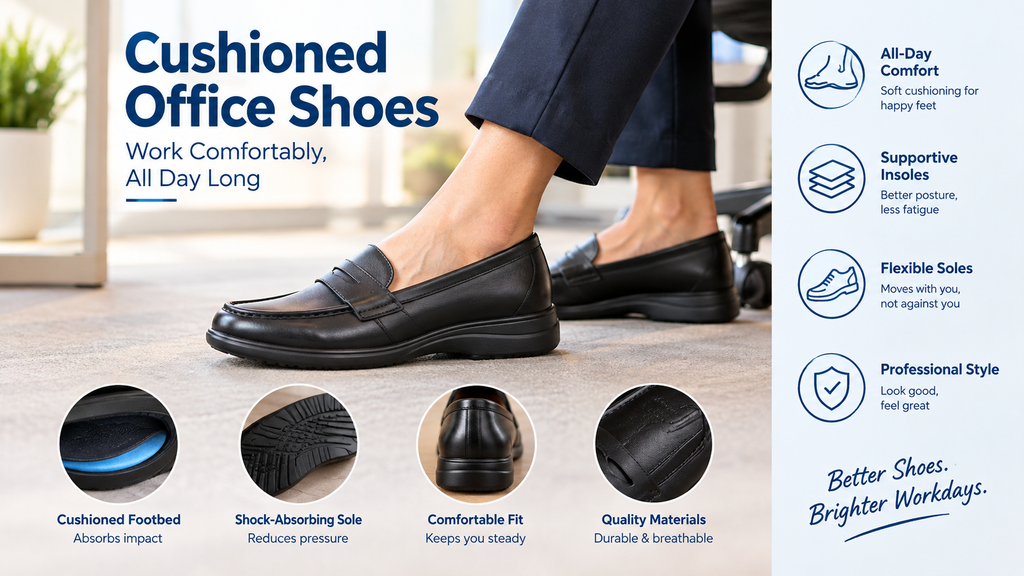
Cushioned Office Shoes: A Complete Guide to Comfortable Footwear for Work
Article Outline
- H1: Cushioned Office Shoes: A Complete Guide to Comfortable Footwear for Work
- H2: What Are Cushioned Office Shoes?
- H3: How Cushioning Works
- H2: Why Cushioning Matters at Work
- H3: The Effect of Long Hours on Your Feet
- H2: Key Features of Comfortable Office Shoes
- H3: Supportive Insoles
- H3: Flexible and Shock-Absorbing Soles
- H2: Cushioned Office Shoes for Standing Jobs
- H3: Why Standing All Day Can Be Uncomfortable
- H2: How to Choose the Right Cushioned Office Shoes
- H3: Getting the Right Fit
- H2: Best Materials for Cushioned Office Shoes
- H2: Cushioned Office Shoes for Men
- H2: Cushioned Office Shoes for Women
- H2: Formal Style Without Sacrificing Comfort
- H2: Cushioned Office Shoes vs. Regular Dress Shoes
- H2: How to Test Office Shoes Before Buying
- H2: Common Mistakes When Choosing Office Shoes
- H2: How to Care for Cushioned Office Shoes
- H2: When Should You Replace Office Shoes?
- H2: Conclusion
- H2: FAQs
- H2: What Are Cushioned Office Shoes?
What Are Cushioned Office Shoes?
Cushioned office shoes are work-appropriate shoes designed with additional padding, shock absorption, and underfoot comfort to make long periods of walking or standing easier on the feet. Unlike very rigid dress shoes that may prioritize appearance over comfort, cushioned footwear attempts to combine a professional appearance with practical support. Cushioning can come from the insole, midsole, heel area, or a combination of several layers, depending on the shoe design. The goal is not simply to make a shoe feel soft when you first put it on; a good office shoe should also provide a stable base, enough room for natural foot movement, and a secure fit throughout the working day.
This distinction matters because office workers do not all have the same routine. One person may spend most of the day sitting at a computer, while another may walk between meetings, move around a workplace, or stand for several hours. NIOSH notes that prolonged standing can be associated with fatigue, discomfort, leg symptoms, and low-back pain, while interventions can include appropriate footwear, shoe inserts, and changes to the work environment. Cushioned office shoes therefore make the most sense when their design matches the actual demands of your working day. Think of cushioning like a small buffer between your feet and the floor: it does not solve every footwear problem, but the right amount can make everyday movement feel considerably more comfortable.
How Cushioning Works
Cushioning works by providing a layer between your foot and the ground that can absorb and distribute some of the forces created while walking. Common cushioning materials include foam compounds, molded footbeds, padded insoles, and specially designed midsoles. Different materials behave differently, so a shoe that feels extremely soft in a store is not automatically the most comfortable option for eight hours of work. Too little cushioning can make hard floors feel unforgiving, while excessive softness may make some people feel less stable.
The best choice depends on the person, the shoe construction, and the workplace. A cushioned shoe should still feel reasonably stable when you walk, turn, and stand. Research and workplace guidance also show that footwear characteristics can affect comfort and standing or postural behavior, which means cushioning is only one part of the overall design. Instead of asking, “How soft is this shoe?” ask a broader question: “Does this shoe give me comfortable cushioning while still allowing me to walk naturally?” That simple change in thinking can help you avoid choosing footwear based only on the first few minutes of comfort.
Why Cushioning Matters at Work
Office floors can be harder on your feet than they initially seem. Walking repeatedly across tile, concrete, wood, or other firm surfaces creates repeated contact between your footwear and the ground. Even if each individual step feels insignificant, hundreds or thousands of steps during a working day can add up to noticeable fatigue. For people who alternate between sitting, walking, and standing, footwear becomes one small part of the overall ergonomic picture.
The CDC’s National Institute for Occupational Safety and Health recommends attention to properly designed work environments and notes that workers should avoid sitting or standing for excessively long periods where possible. Earlier NIOSH research also identified prolonged standing as a source of fatigue and discomfort and discussed footwear, shoe inserts, mats, and sit-stand options as possible workplace interventions. That does not mean cushioned shoes can prevent every work-related ache or injury. Instead, they can be one practical component of a more comfortable setup, especially when combined with appropriate movement, workstation design, and breaks.
The Effect of Long Hours on Your Feet
A normal office day may involve far more movement than you realize. You might walk to another department, visit a printer, climb stairs, attend meetings, stand while speaking with colleagues, or commute before and after work. People working in retail, healthcare, hospitality, education, security, and similar environments may spend substantially more time on their feet than traditional desk workers.
Prolonged standing has been associated with increased reports of physical fatigue, muscle discomfort, leg swelling, tiredness, and low-back pain in occupational research. This is why choosing comfortable work shoes should not be treated as a purely cosmetic decision. A professional-looking shoe that becomes painful after several hours may be less useful than a shoe that combines a polished appearance with practical comfort. If your job keeps you moving, your footwear should be considered part of your everyday work equipment, just like your chair, desk, computer, or work bag.
Key Features of Comfortable Office Shoes
The best cushioned office shoes usually combine several features rather than relying on cushioning alone. Look for a supportive footbed, adequate forefoot space, a stable heel, comfortable materials, and a sole that bends naturally where the foot bends. A shoe should hold your foot securely without squeezing it, and it should feel stable when you change direction. These characteristics can make a bigger difference than simply selecting the thickest possible sole.
Professional footwear also needs to match the workplace. A sleek leather loafer may work well in a formal office, while a conservative cushioned sneaker may be more appropriate in a business-casual environment. Some workplaces also require specific protective characteristics, such as slip resistance or protective toes. CDC workplace guidance emphasizes that shoe fit and comfort matter when selecting occupational footwear, while protective footwear standards address specific workplace hazards. Therefore, consider your workplace rules before buying a shoe simply because it looks comfortable.
Supportive Insoles
A good insole can significantly influence how an office shoe feels because it is the part of the shoe that directly supports the bottom of your foot. Some insoles are lightly padded, while others use molded contours or removable cushioning. The ideal insole should feel comfortable without creating pressure points. If the insole is removable, you may also have the option of replacing it with another suitable insert, although an insert is not automatically the answer to every foot or back problem.
The shape matters as much as the softness. Your heel should feel secure, while the front of the shoe should allow your toes to move naturally. If your toes are pressed together, extra cushioning will not fix the underlying fit problem. Workplace research has examined shoes and inserts as potential interventions for standing-related discomfort, but results vary by situation, which is another reason to focus on the entire shoe rather than one feature. A comfortable insole should work together with the shoe’s sole and upper instead of trying to compensate for poor construction.
Flexible and Shock-Absorbing Soles
The outsole and midsole play a major role in how an office shoe behaves during walking. A useful sole generally provides enough cushioning to make hard surfaces more comfortable while maintaining sufficient stability. Flexibility can also help the shoe move naturally with your foot instead of feeling like a rigid board attached to your heel. However, a completely soft and unstable sole is not necessarily better.
A balanced design is often more practical for everyday office use. The heel should feel stable when you land, the forefoot should allow normal movement, and the sole should provide appropriate traction for the surfaces you regularly encounter. Research on footwear and workplace movement shows that shoe characteristics can influence comfort and postural strategies, demonstrating that footwear design is more complex than simply adding foam. When shopping, walk around rather than judging the sole while standing still. A shoe can feel soft in place but behave very differently once you start walking.
Cushioned Office Shoes for Standing Jobs
People who stand for much of their working day have different footwear needs from someone who sits at a desk. Cashiers, reception staff, teachers, healthcare workers, retail employees, security personnel, and many other professionals may spend hours standing or walking. In these situations, cushioned office shoes for standing can provide a useful combination of underfoot padding and workplace-appropriate style.
NIOSH’s review of prolonged standing found evidence connecting extended standing with discomfort and fatigue and discussed footwear, shoe inserts, mats, and sit-stand options among possible interventions. Another workplace report specifically recommended shoes with well-cushioned insteps and insoles to improve comfort in a job involving substantial standing. Still, footwear is only one piece of the solution. If your job requires standing continuously, changing posture, taking appropriate breaks, moving when possible, and improving the surrounding work environment can also matter.
Why Standing All Day Can Be Uncomfortable
Standing in one position for a long period is different from walking naturally throughout the day. When you remain relatively stationary, your muscles and joints may stay under continuous load, while the hard surface beneath you provides little forgiveness. NIOSH has described static standing as a workplace concern and identified options such as alternative postures, movement, resilient surfaces, and shoe inserts as potential approaches.
This is where a thoughtfully designed office shoe can become useful. A cushioned footbed may make the floor feel less harsh, while a stable sole can provide a more secure base. However, the shoe should not encourage you to remain completely still for hours. Movement remains important, and your workplace setup should allow you to change positions whenever practical. In other words, cushioning is more like a helpful teammate than a complete solution: it can contribute to comfort, but it cannot replace good workplace ergonomics.
How to Choose the Right Cushioned Office Shoes
Choosing cushioned office shoes starts with understanding your own working routine. Ask yourself how many hours you spend sitting, standing, and walking, and consider the surfaces you normally walk on. Think about whether you need formal leather shoes, business-casual footwear, or a more relaxed style. Also consider whether your workplace has requirements involving colors, materials, heels, slip resistance, or protective features.
Next, focus on construction. Look for cushioning that feels supportive rather than excessively soft, a sole that provides reliable traction, and an upper that does not create pressure around your toes or heel. If you wear the shoes for many hours, breathable materials can also make a noticeable difference. A shoe that looks excellent but traps heat, rubs the heel, or squeezes the forefoot may become frustrating by lunchtime. Your goal should be a shoe that feels so naturally comfortable that you stop thinking about it during your workday.
Getting the Right Fit
Fit is one of the most important parts of comfortable footwear. Your heel should stay reasonably secure while walking, and your toes should have enough space to move without hitting the front of the shoe. Do not assume that the same size will fit identically across different brands or styles. Shoe shapes vary considerably, so the number printed inside the shoe is only a starting point.
Try shoes on at a time when your feet are not unusually compressed from a long day. Wear the type of socks you normally use at work and walk around in the shoes for several minutes. Pay attention to pressure points around the toes, sides, heel, and top of the foot. CDC workplace guidance specifically notes that employees should have an opportunity to try on footwear to obtain proper fit or exchange shoes when necessary. A comfortable fit is more valuable than choosing a particular brand simply because it is popular.
Best Materials for Cushioned Office Shoes
Materials influence comfort, durability, appearance, and breathability. Leather remains a popular option for formal office footwear because it can provide a polished appearance and may develop a distinctive look with use. Synthetic materials can also work well and are often easier to clean, while engineered textile uppers may offer additional breathability for casual office designs. The best material depends on the climate, workplace dress code, maintenance routine, and personal preference.
The inside of the shoe matters just as much as the outside. A soft lining can reduce friction, while a breathable upper may help manage heat during long working hours. Cushioning materials also differ in how they respond to repeated compression. When choosing a shoe for daily use, consider the complete construction rather than focusing on one material advertised on the product page. A professional shoe should ideally combine a comfortable interior, durable exterior, suitable cushioning, and a sole that matches your daily environment.
Cushioned Office Shoes for Men
Men’s cushioned office shoes are available in several styles, including traditional dress shoes, loafers, derby-style shoes, monk straps, and business-casual designs. A formal workplace may favor a sleek leather appearance, while a relaxed office may allow a minimalist sneaker or casual loafer. Regardless of style, the same fundamental comfort principles apply: appropriate cushioning, a good fit, stable construction, and enough room for the toes.
A useful approach is to match the shoe’s formality to the workplace while prioritizing how you actually use it. Someone who sits behind a desk for most of the day may have different requirements from someone who walks between departments or stands during presentations. If you need a formal appearance, look for dress shoes with padded insoles and shock-absorbing midsoles rather than assuming every comfortable shoe must look athletic. Modern footwear design can combine a traditional upper with a more comfort-focused sole, giving you a professional appearance without automatically choosing a rigid shoe.
Cushioned Office Shoes for Women
Women’s cushioned office shoes include flats, loafers, low heels, dress shoes, supportive sneakers, and other professional styles. The right option depends on workplace expectations and personal comfort. If you prefer heels, consider the height, stability, fit, and amount of time you will spend walking or standing. A lower, stable heel may feel very different from a narrow high heel during a long workday.
Comfort should not be sacrificed simply because a shoe looks elegant. NIOSH research on prolonged standing has specifically discussed increased musculoskeletal discomfort in workers wearing high heels in certain standing occupations. This does not mean every heel is unsuitable for every person or job; rather, it highlights why footwear choice should reflect the amount of standing and movement required. A polished flat, cushioned loafer, or low-heel shoe can provide another option when long periods on your feet are part of the job.
Formal Style Without Sacrificing Comfort
One common misconception is that comfortable shoes must look like athletic shoes. That may have been more common in the past, but modern office footwear offers many designs that combine professional styling with comfort-focused construction. A sleek loafer can contain a padded footbed, while a traditional-looking lace-up shoe may use a flexible rubber sole. Business-casual shoes can also provide cushioning without looking overly sporty.
The key is to examine the construction instead of judging the shoe only by its appearance. Look for subtle cushioning, a practical heel height, adequate toe space, and a sole that bends naturally. If you need a formal appearance every day, consider keeping different pairs for different situations. One pair might be optimized for meetings, another for walking-heavy days, and another for occasions where you need maximum formality. That approach can extend the life of each pair while giving your feet a more suitable option for different workdays.
Cushioned Office Shoes vs. Regular Dress Shoes
| Feature | Cushioned Office Shoes | Traditional Dress Shoes |
|---|---|---|
| Underfoot cushioning | Usually higher | Often limited |
| Walking comfort | Designed with everyday movement in mind | Depends heavily on construction |
| Office appearance | Available from casual to formal | Usually highly formal |
| Flexibility | Often moderate to high | Can be relatively rigid |
| Standing comfort | Often prioritized | Varies by design |
| Insole padding | Common | Varies considerably |
| Best use | Long workdays, walking, mixed office routines | Formal occasions and traditional offices |
The difference is not simply “comfortable versus uncomfortable.” Some traditional dress shoes are extremely comfortable, while some heavily cushioned shoes can feel unstable or poorly fitted. The important question is whether the construction suits your feet and your daily routine. Cushioning, flexibility, fit, stability, materials, and workplace requirements all interact.
For people who spend long hours standing, workplace research supports considering appropriate footwear as part of a broader strategy for reducing discomfort. That makes it useful to evaluate shoes based on function rather than labels. A shoe can be marketed as a “comfort shoe” and still be the wrong choice for you if its shape does not fit your foot.
How to Test Office Shoes Before Buying
Testing footwear before buying can prevent many common problems. Start by putting both shoes on, because your feet may differ slightly in size or shape. Stand up and walk naturally across a hard surface if possible. Bend, turn, and take several normal steps rather than simply standing in front of a mirror.
Pay attention to several areas. Your toes should not feel cramped, your heel should not repeatedly slide, and the upper should not dig into the top or sides of your foot. The cushioning should feel comfortable but not so soft that you struggle to maintain a stable stance. If a shoe causes immediate rubbing or pressure in the store, do not assume it will magically become perfect after a few wears.
A useful test is to imagine wearing the shoes during your most demanding workday. If you have to walk between buildings, stand during meetings, or commute on foot, test the shoes accordingly. Comfort should be considered over the entire movement pattern, not just the first impression.
Common Mistakes When Choosing Office Shoes
One of the biggest mistakes is buying shoes based entirely on appearance. A beautiful shoe can become a daily annoyance if it does not fit correctly. Another mistake is assuming that more cushioning always means more comfort. Excessive softness, poor stability, or a badly shaped footbed can create a different set of problems.
People also sometimes buy shoes that are too small because the fit looks better or because they expect the material to stretch. While some materials may soften or change slightly with use, a fundamentally poor fit should not be relied upon to improve. Another common mistake is ignoring workplace requirements. If your job requires slip resistance, protective toes, or another specific feature, ordinary cushioned office footwear may not satisfy the requirement. CDC guidance distinguishes protective footwear according to workplace hazards and applicable standards, so safety requirements should come before style.
How to Care for Cushioned Office Shoes
Proper care can help office shoes maintain their appearance and performance for longer. Rotate your footwear when possible rather than wearing exactly the same pair every working day. Allowing shoes to air out between uses can help the interior dry, particularly if your feet become warm during long workdays. Follow the manufacturer’s cleaning instructions because leather, synthetic materials, suede, and textile uppers require different maintenance.
The cushioning also deserves attention. If the insole becomes flattened, damaged, or uncomfortable, inspect whether it can be replaced. Do not continue wearing footwear that has developed sharp internal edges, broken support structures, badly worn soles, or other defects. Cleaning the upper while neglecting the sole and interior does not fully maintain a shoe.
A simple maintenance routine can also help you notice problems early. Check the outsole for uneven wear, examine the heel for excessive compression, and inspect the stitching and upper periodically. Shoes are everyday equipment, and like any frequently used equipment, they eventually show signs of wear.
When Should You Replace Office Shoes?
There is no single replacement date that works for every person because shoe life depends on construction, usage, body weight, walking distance, surfaces, and maintenance. Instead of relying only on a calendar, examine the condition of the shoes. If the cushioning feels significantly compressed, the sole is worn smooth, the heel becomes unstable, or the upper no longer holds the foot securely, it may be time to consider a replacement.
Uneven wear can also be useful information. If one section of the outsole is wearing much faster than another, the shoe may no longer provide the same stable platform it did when new. A visibly damaged shoe should not be kept simply because the upper still looks attractive.
For people who wear one pair every day, rotating between two or more suitable pairs may help distribute wear. It can also give each pair time between uses. Most importantly, do not wait for a shoe to become completely unusable before considering replacement. If the footwear is no longer comfortable or appropriate for your work environment, its useful life may already be over.
Conclusion
Cushioned office shoes can be a practical choice for people who want professional footwear without giving up everyday comfort. The most useful pair is not necessarily the softest, most expensive, or most fashionable option. Instead, look for a combination of appropriate cushioning, a secure and comfortable fit, sufficient toe room, useful flexibility, stable construction, and a style that matches your workplace.
Your work routine should guide your decision. A desk worker, teacher, retail employee, healthcare professional, and office manager may all need different footwear because they spend different amounts of time sitting, walking, and standing. Research from NIOSH indicates that prolonged standing can contribute to fatigue and discomfort and identifies footwear among several possible workplace interventions.
The smartest approach is therefore to treat footwear as one part of overall workplace comfort. Combine suitable shoes with movement, sensible breaks, an ergonomic workstation, and appropriate workplace practices. When your shoes fit properly and provide the cushioning and stability your routine requires, you can spend less time thinking about your feet and more time focusing on your work.
FAQs
1. What are cushioned office shoes?
Cushioned office shoes are professional or business-casual shoes designed with padding or shock-absorbing materials to improve underfoot comfort. They may include cushioned insoles, padded footbeds, flexible midsoles, or supportive soles.
2. Are cushioned office shoes good for standing all day?
They can be useful for people who spend significant time standing because cushioning may improve underfoot comfort. However, footwear is only one part of managing prolonged standing, and changing positions and moving when practical are also important.
3. What should I look for in comfortable office shoes?
Look for a secure heel, sufficient toe space, comfortable cushioning, appropriate flexibility, good traction, and materials suitable for your workplace and climate. Most importantly, the shoes should fit your feet properly.
4. Can cushioned shoes look professional?
Yes. Many modern loafers, dress shoes, flats, and business-casual shoes use comfort-focused construction while maintaining a professional appearance. You do not necessarily need athletic-looking footwear to get additional cushioning.
5. How often should I replace cushioned office shoes?
Replacement depends on how frequently you wear them and how quickly they wear. Consider replacing them when the cushioning becomes compressed, the outsole is excessively worn, the heel becomes unstable, or the shoe no longer provides a comfortable and secure fit.
Pingback: Closed Toe Shoes: Comfort, Style & Protection